On Oct 2nd 2023 the Government announced it's new 30-point plan to "put drivers back in the driving seat". Read the Department for Transport article here. In the article below, previous RIN president, James Taylor, shares his own thoughts about how charges imposed on road users in the UK are utilised regarding the improvement of infrastructure and safety.
The Cost of Navigating Our Roads
James Taylor, RIN Past President, shares his concerns about how charges imposed on road users in the UK are utilised regarding the improvement of infrastructure and safety.
This article was first published in the March-April 2023 edition of Navigation News. View the full archive here.
The Royal Institute of Navigation, as a professional body and as a learned society, concentrates on Positioning, Navigation and Timing, and on Resilience. It does so in air, space, at sea and on land. In each of those sectors, the provision of supporting infrastructure, of resilience and accuracy, of effectiveness and efficiency, costs money. And where costs are involved, added value taxes and surcharges can be deployed by the provider, or by local or central Government, to change or to fine-tune behaviour, or to raise revenue. These remain the long-standing bases of any form of taxation.
In air transport, operating companies and ultimately passengers using a typical UK airport can expect to pay, amongst others:
• Passenger Load Supplement
• Passenger Reduced Mobility charge
• Ground Handling System charge
• Baggage Reconciliation charge
• Hold Baggage Screening charge
• CAA Aviation Security charge
• Noise Violation charge
There is also a Navigation charge, for operating local navigational aids and air traffic services, and usually based on take-off weight. At the same time, the UK Government places a surcharge called Air Passenger Duty on each and every ticket, a complex system of variable rates of tax depending on destination and where you sit on-board the aeroplane, in the smart seats or “cattle class”. Flying costs money.

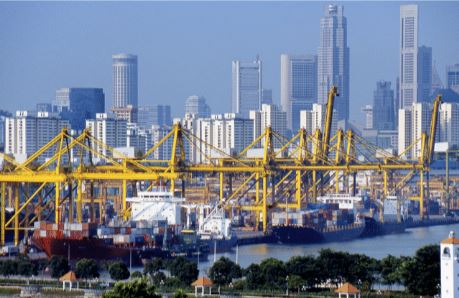
For ports and harbours, the situation is even more complex. Bearing in mind that some 95% of all UK import and export tonnage arrives or departs by sea, every port and harbour requires an efficient and effective infrastructure to keep it moving. And that, too must be paid for, initially by the shipping owner or operator, or by the port authority, but ultimately by the end-user, the consumer. In any port of significant size, users can expect to be pay, on a sliding scale for every registered tonne, or per passenger:
• Berthage fees
• Port conservancy dues
• Pilotage and towage fees
• Light dues to provide for aids to navigation
• Hydrographic charges
• Gangway fees;
• Plant, cranage and labour charges
• Bunkering fees
• Security and allied charges
• Demurrage;
• Waste management charges
• Others, too numerous to mention
Moving goods and people by sea is not cheap.
What of land transport? In recent years, the RIN has increased its involvement in safe navigation for hill walkers and those making their own way around our landscape, using maps and hand-held navigation, and traditional skills. But road transport is rather taken for granted; it is seen as requiring perhaps little in pure navigational skills, thanks to road signage and near-ubiquitous on-board, space-based navigation systems. The road will go where it goes, and you will follow that road. Yet the national and local road network requires massive expenditure on its infrastructure, to keep it in sound working condition, and to keep users safe, just as for air and sea. How we currently do that is different... and perhaps that needs to change. The UK’s road network, some quarter of a million miles in all, is funded by both national and local government, and any development is subject to the labyrinthine planning system, which differs in various parts of the UK. So you may want a new road, or an improved, safer road here, or there, but it will require funding, and national or local governmental approval, and planning permission, often after a lengthy and occasionally obstructive planning inquiry. Bear in mind, too, that local and regional government obtains the vast majority of its funding from central, UK Government.
Some time ago, every vehicle in the UK paid an annual fee–“Road Tax” into the Road Fund, which was set aside for road building and improvements. But that came to an end and, decades ago, Road Tax became Vehicle Excise Duty, a complex and frequently changing sliding scale of charges depending on engine size. Its proceeds, some £7 billion per annum, went directly to the Exchequer for deployment wherever the UK Government wanted. Although there are exceptions. Cars over 40 years old pay no VED at all!

A much bigger tax take from motor vehicles comes from fuel duty, the surcharge you pay to the Exchequer on the fuel you put in your tank. This provides a further sum in excess of £35 billion per annum to the Government. Together, these provide about 4% of all Government tax revenue. And although that provides a large pot for local government to dip into to improve road transport infrastructure and safety, central government, especially in time of financial difficulties, may choose not to make it available. That pot will dry up completely in time, as new petrol and diesel vehicles will be banned from 2030-2035.This system of raising revenue via fossil-fuelled vehicular charges has a number of inbuilt problems, but chief amongst these are the increase in electrical vehicles (EVs) which will pay no VED until 2025, and which will raise only some £1.5billion per annum, but not until 2027/8. Meanwhile, the use of a fuel duty surcharge, as we have now, means that when fuel prices are volatile, as now, any increase in fuel price is exaggerated by the addition of fuel duty and VAT, which means that inflation also ratchets up, but as a result of the Government’s own decisions. We saw with aviation and maritime that at least some of the charges imposed on users are deployed to improve infrastructure and safety. How can we do this in the UK for our creaking road system?...

 Blog Home
 All Blogs
 RSS
RSS

