The speaker at this annual event, at which the Small Craft Group arrange the speaker and the Cruising Association Host us, was Ivana Carrioni-Burnett, Chair of the Maritime Navigation Group. Her topic was that of Piloting the Thames Estuary.
Words by John Hasselgren
Ivana was always fascinated by the sea and knew she wanted to work afloat. At school she decided to give up the arts and concentrate on subjects that would further her ambition. Joining the Sea Cadets, her parents expected her to dislike the routine and leave; instead, she enjoyed it and after her A level exams went to RNC Dartmouth to train as an RN Officer.
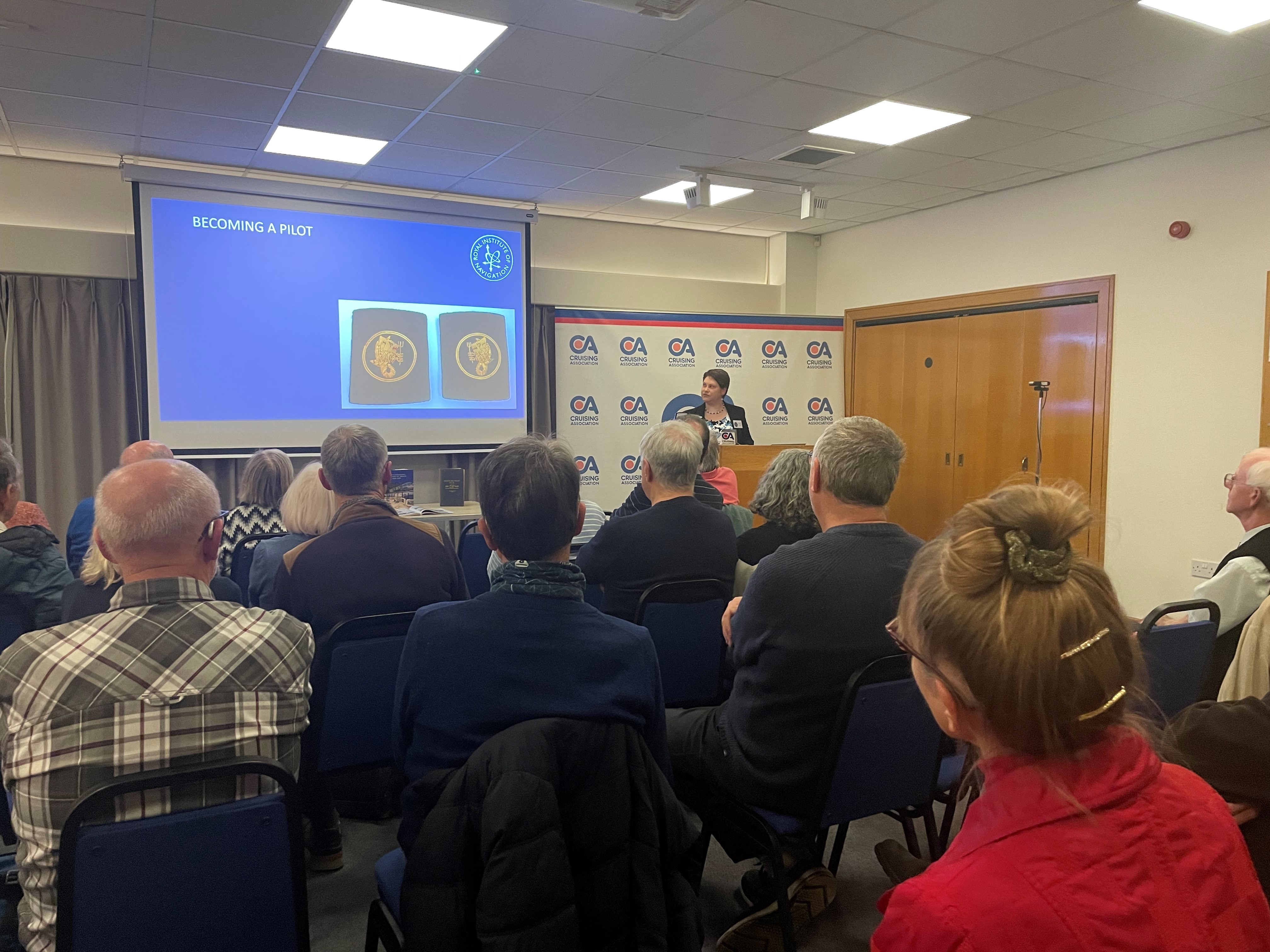
After her training Ivana was drafted to a series of warships, the list of which seemed to be longer than the number of ships that we have these days. On board HMS Severn she continued her Officer of the Watch training, eventually becoming a qualified OOW on board HMS Roebuck.
After service in HMS Argyle, and HMS Daring in the Middle East, Ivana undertook the Hydrographic Course. Service in HMSs’ Echo, Enterprise and Tyne followed before becoming a Navigation Instructor at the stone frigate HMS Collingwood. Leaving the Royal Navy after eleven years service, Ivana decided she still wanted to work at sea, so became a Port of London pilot. In addition to this she still finds time to Chair the Royal Institute of Navigation’s Maritime Navigation Group and be an Advisory Member of the PLA.
The Port of London, its limits being shown on the map projected onto the screen, is the UK’s largest port, based on the tonnage of goods and the number of vessels. It is a Competent Harbour Authority and a Trust Port, having no shareholders. Under the Pilotage Act of 1987 it employs Ivana as a Marine Pilot. Because of the length of the Thames, the harbour stretching from the Gunfleet Old Lighthouse off Frinton in Essex to Teddington lock to the west of London, the pilotage is divided between Sea Pilots and River Pilots, the changeover being at Gravesend.
In the year1510 a Pilot was described as one who steered a vessel, but by 1640 this had changed to one who guides, leads or directs its course. To become a pilot Ivana had to learn all the channels in and around the Thames Estuary, spend time in a simulator and pass three exams. Even when once qualified a new pilot will only be allowed to bring in and out small vessels, with further training and assessment before moving up to larger ships, then eventually to the largest. The largest container ships require the use of two pilots
There are 130 pilots working for the PLA, with only 3 of them being women. They work in 15 watches, with 9 days on duty followed by 6 days off. Between them they pilot a great range of ships. Occasionally they will provide pilotage for towage; this was especially so during the construction of the new stand at Fulham Football Club’s Craven Cottage ground on the banks of the river.
Ivana qualified as a Pilot pre-Covid so during the pandemic she was named as a key worker and thus able to continue working and avoid the instruction to ‘stay at home’. She was, though, expected to keep to the 2 metre distance and to wear a mask.
Regarding pilotage, Ivana considers it to be, sometimes, a ‘contact sport’. Paint is occasionally scraped off and guardrails will get bent. Since the Thames has strong tides, she tries to use them to best advantage. Wind can be a problem, especially with 30 knots acting on a container ship. This is especially true when entering Tilbury Lock. Fog can also cause problems, drifting off the surrounding marshes onto the river. Pilots like to make trips on board tugs to gain experience of working with them.
Ladders. This was something which was a regular complaint when I used to attend the monthly Joint Informal Meeting on board HQS Wellington. It seems it hasn’t gone away. Up to a height of 9 metres the pilot is expected to climb up the pilot ladder. Ivana’s advice is to ‘think squirrel’ and climb quickly above the level at which the pilot vessel can hit the ladder. She also advocates using the ‘three points of contact’ technique. Above 9 metres an accommodation ladder should be provided with the platform, reached from the pilot ladder, being 5 metres above the water (and above the pilot vessel) and horizontal with suitable handholds. When the pilot ladder is used all the way to the deck of the ship the handholds at the rail are often poor, round ones being preferable to flat bars. Although she can report ships with poor ladders or handholds, Ivana prefers to work with the ship and persuade it to improve things for next time.
The weather presents other problems besides its effect on the ship. It can also make it difficult for the pilot to embark or disembark. The wind, especially a strong north-easterly, will sometimes make it impossible to get on or off the ship. If the Sunk pilot vessel is off station when outbound, the next one is off Belgium. Pilots carry their passport with them!
She carries a tablet computer with all the data she needs. However, she likes also to carry a pack containing print-outs of tidal information, regulations etc. to ensure everything is to hand. Belt and braces!
Once on board the pilot is fed by the ship. Her preference is for Turkish Container ships; Ivana says she is always greeted with an excellent cup of coffee when she boards.
Ivana was very complimentary about the boatmen, the linesmen who run the lines ashore. They really know their stuff, is her view (take a look at her View from The Bridge webinar series on YouTube)
On leisure vessels, Ivana recommended them to download the great amount of free advisory material on the PLA web site. This would enable them to navigate their vessel in safety in these confined waters that can present dangers. They could also join the Tidal Thames Navigation Club – details on the PLA web site. Yachts are often difficult to contact by radio as they tend to listen to VHF channel 16; it would be preferable for them to monitor the correct working channel for the area. Ivana also issued a warning to yachts in Sea Reach – new berths were being built both above and below those already in use at London Gateway Port. Ivana recounted an experience with a tanker at low water, needing to stay in the centre of the channel while rounding Tilbury Ness. Round the bend towards them came a small motor cruiser carefully staying in mid-channel! Jet Skiers came in for strong criticism, with Ivana wishing she was back in the Royal Navy and could order the weapons crew to close up.
Finally, Ivana recommended the London Museum in Docklands to anyone wishing to know more about the history of the River Thames, and asked those who went to sea to complete the RIN Maritime Report survey on the degradation and loss of GNSS.

 Blog Home
 All Blogs
 RSS
RSS


Posted 16 hours ago